THE CRAFT
Shadow-Dried. Never Sun-Dried.
The difference between medicine and mulch is four hours and a patch of shade.
THE CRAFT
The difference between medicine and mulch is four hours and a patch of shade.
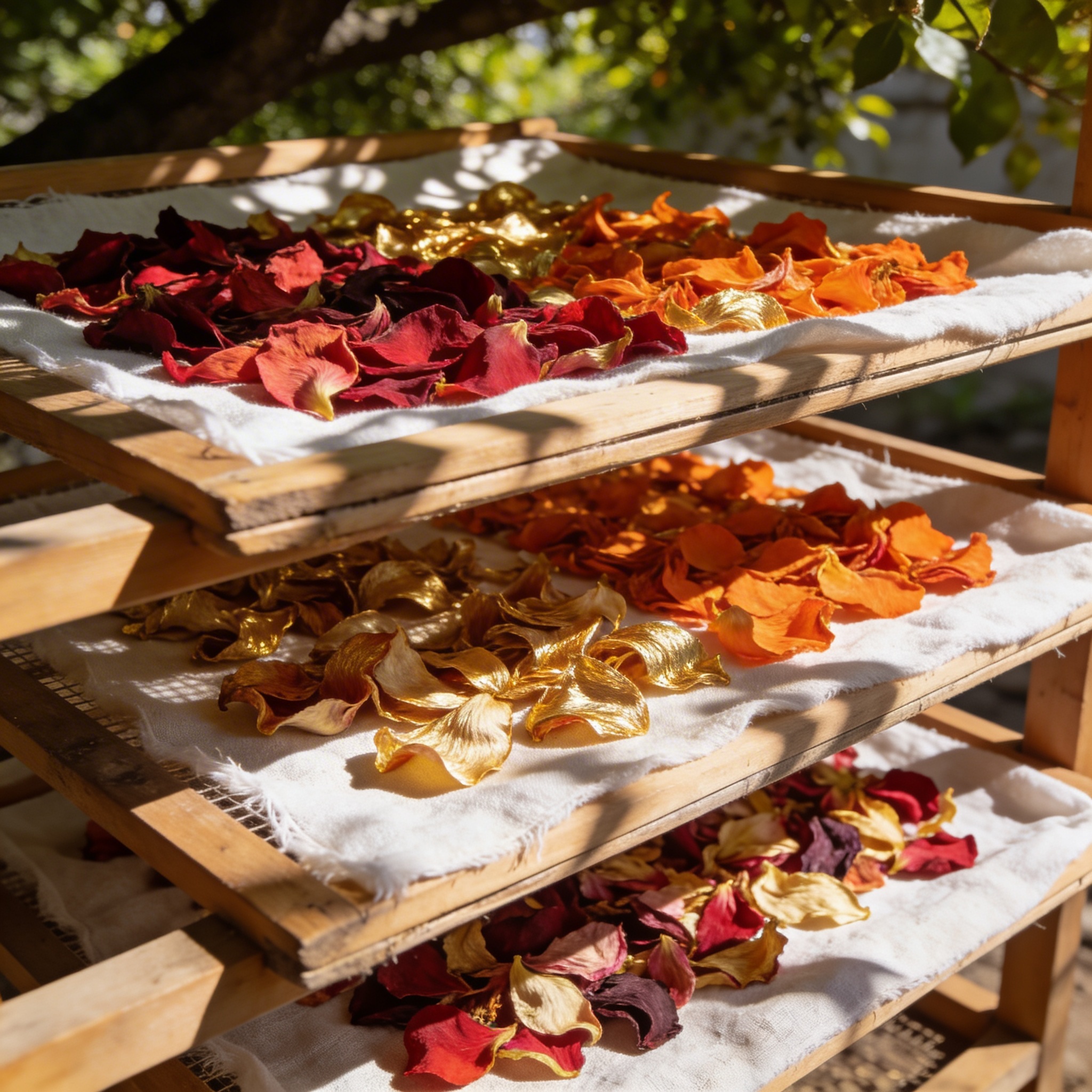
Shadow-drying preserves volatile oils. Sun-drying destroys them. This is not opinion — it is chemistry. Ultraviolet radiation breaks down the terpenes, phenolics, and anthocyanins that give flowers their colour, aroma, and therapeutic compounds.
Temperature never exceeds 35 degrees Celsius. Airflow is constant but gentle — enough to carry moisture away, never enough to scatter petals. The racks are bamboo, spaced to allow circulation from below. The rooms are ventilated but never exposed to direct light.
This is how apothecaries dried herbs for centuries before industrial processing decided speed was more important than quality.
Each flower has its own harvest window. Miss it and you lose the compounds that make the flower worth drying.
February to April. Picked at dawn, before the sun warms the petals and the volatile oils begin to evaporate. The window is narrow — a rose picked at noon has lost half its fragrance to the air.
October. Two weeks only. The entire annual harvest of Pampore happens in fourteen days. Each flower is picked at dawn and the stigmas are separated by hand within hours. Delay means degradation.
Evening, when the buds are still closed. An open jasmine flower has already released its fragrance. We buy closed buds and dry them immediately — so when you steep them, the bud opens in the water and the aroma is yours, not the air's.
Summer in Himachal Pradesh, a six-week window at altitude. The flowers are smaller and more concentrated than lowland varieties — more oil per gram because the plant produces it as UV protection.
Morning, when anthocyanin concentration peaks. The deep blue colour is the antioxidant — if the blue fades, the benefit fades. Our drying preserves the blue so completely that a single flower still turns water indigo six months later.
Year-round in Tamil Nadu, but the dry season harvest — December through March — produces flowers with the deepest crimson and highest concentration of Vitamin C.
Shadow-drying is slow. It takes three to five days instead of hours. But what survives is everything that matters.
Our saffron is crimson, not brown. Our butterfly pea is indigo, not grey. Our hibiscus is deep red, not maroon. Colour is not cosmetic — it is a direct indicator of compound preservation.
Jasmine still fragrant after six months. Rose still perfumed after four. Chamomile still smells like chamomile, not hay. The volatile oils that create aroma are the first casualties of heat and UV — we expose our flowers to neither.
Butterfly pea still turns water indigo because the anthocyanins survived. Hibiscus still lowers blood pressure because the organic acids survived. Saffron still colours food gold because the crocin survived.
Our flowers are whole. Not crushed, not powdered, not ground into dust for tea bags. You can see the petals, the stamens, the structure. You know exactly what you are steeping.